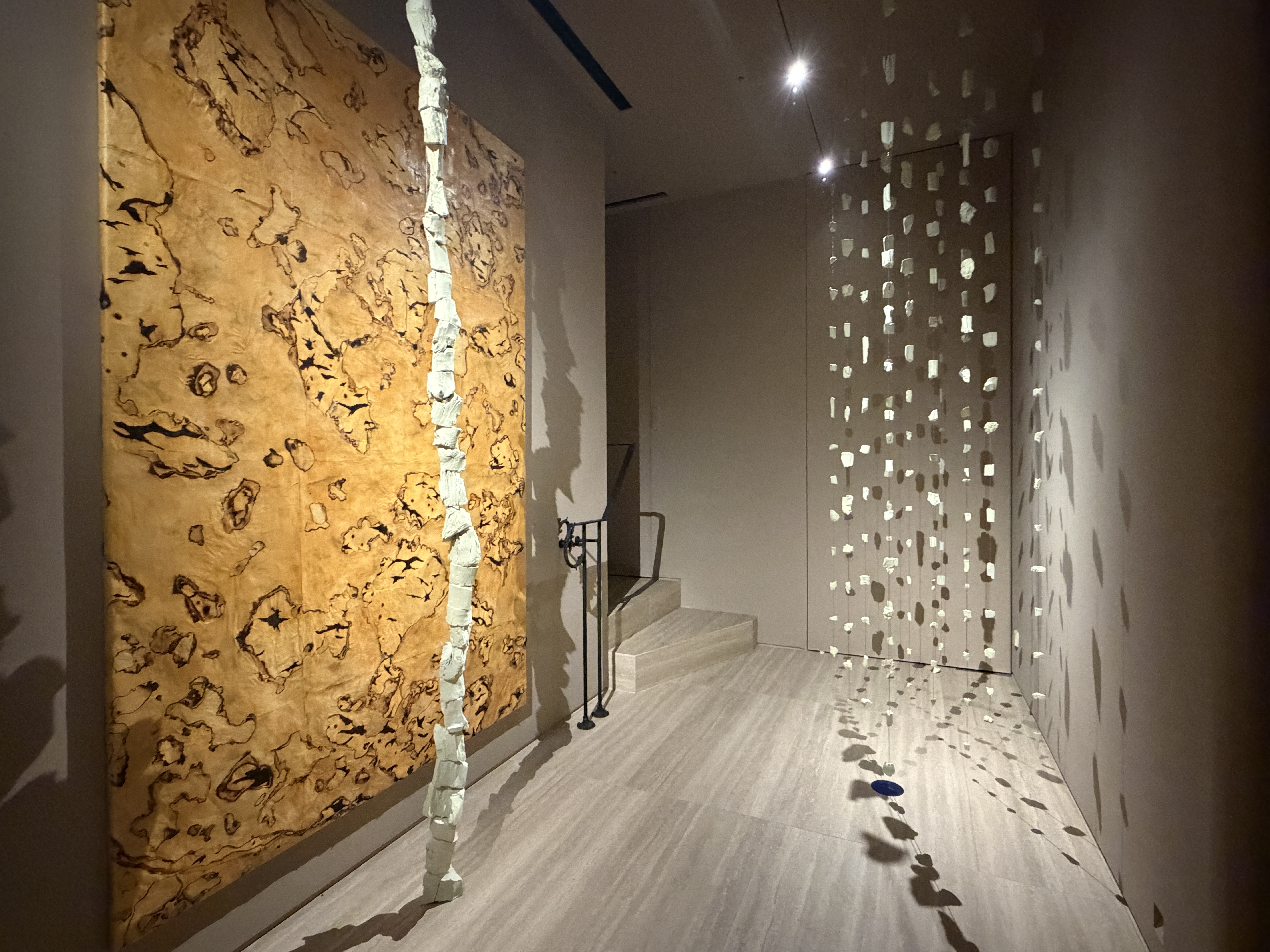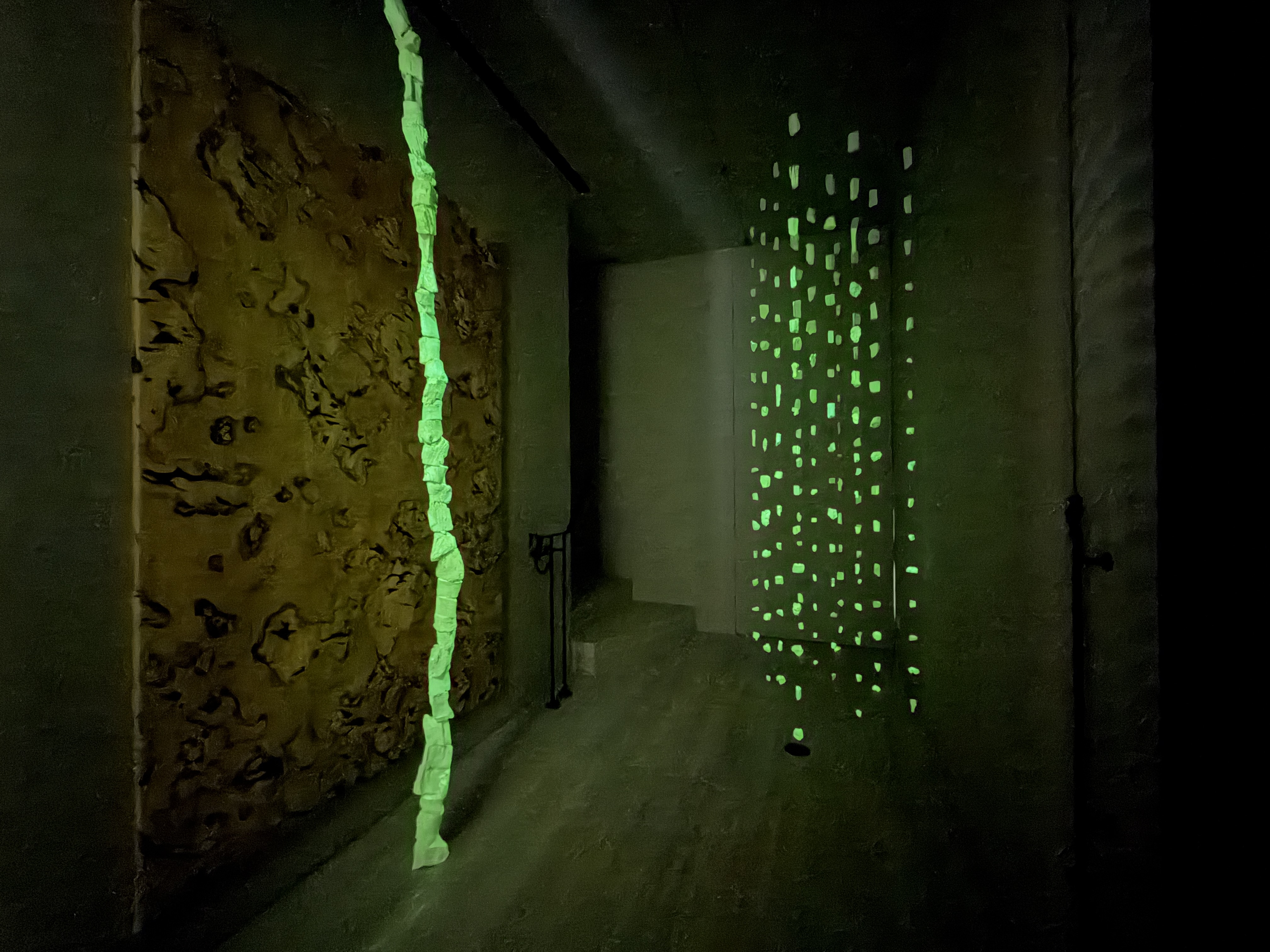
이번 전시는 작가의 가족에 대한 개인적 기억과 그 내면에 깊게 새겨진 감각의 잔향을 짚어내는 작업이다. 전시의 제목인 《Arc of Affection》은 오랜 농사일로 혹등고래의 혹처럼 굽어버린 외할머니의 허리 곡선(Arc)에서 영감을 받은 것으로 헌신과 사랑이라는 단어만으로는 부족한, 가족의 형언하기 어려운 감정들의 형태를 상징한다. 또한 작가의 두 할머니가 보여준 두 개의 각기 다른 빎의 행위와 형식을 통해 한 사회에서 형성된 신념 및 가치체계를 탐구한다.
This exhibition traces personal memories of family and the deeply imprinted echoes of perception held within the artist. Taking its title from the curve of her maternal grandmother's back—bent like the hump of a humpback whale from a lifetime of intense labor—Arc of Affection serves as a metaphor for the complex, indescribable contours of familial emotion that cannot be fully expressed through words like "love" or "devotion" alone. Furthermore, through the two distinct forms and gestures of prayer demonstrated by her two grandmothers, the artist explores the belief systems and values shaped within a society.
1. Everything that flies flies
2026
Layered Korean paper Hanji on canvas, Kongdaem technique, butane torch
243.5 x 154 x 2.5 cm
2. 두 할머니- 탑 쌓기 Two harmony(Two Grandmothers)- Stacking wishes
2026
Charcoal, phosphorescent paint, phosphorescent pigment, stainless steel wire, epoxy glue
330 x 12 x 15 cm
3. 두 할머니- 묵주 엮기 Two harmony(Two Grandmothers)- String wishes
2026
Charcoal, phosphorescent paint, phosphorescent pigment, surgical steel chain
Everything that flies flies
벽면에 걸린 평면 작업은 한지 표면에 불린 백태를 갈아 들기름과 섞어 바르는 전통 기법인 ‘콩댐’을 거친 뒤, 토치로 그을려 완성한 작품이다. 어릴 적 노란 장판에 선명하게 남았던 친할머니의 담뱃불 자국cigarette burns에 대한 작가의 기억이 재료적 시도의 바탕이 되었다.
귀국 후, 작가는 태어났지만 주로 자라지는 않은 고향 평택에서 1년 반 남짓 머물며 유년기 시절 가족에 대한 개인적 기억과 평택이 지닌 지정학적 장소성, 짙은 정서적 화약 냄새와 제트기의 굉음과 같은 군대적 기표, 그리고 전원적 일상이 기묘하게 뒤틀린 평택의 심리적 도시 풍경을 탐구했다. 작품 제목인 《Everything that flies flies》는 철새 떼와 미군 기지 헬기가 동시적 스펙터클을 이루는 평택의 하늘 아래에서 작가의 아버지가 대화 중 남긴 말— “평택엔 날아다니는 것들은 모두 날아다닌다”— 에서 비롯되었다.
The two-dimensional work mounted on the wall was completed through kongdaem—a traditional Korean technique of grinding soaked white soybeans, blending them with perilla oil, and applying the mixture to the surface of Hanji(mulberry paper)—and subsequently scorched with a torch. The material experimentation stems from the artist's childhood memory of the vivid cigarette burns her paternal grandmother left on the yellow linoleum floor.
Upon returning to Korea, the artist spent a year and a half in Pyeongtaek—her birthplace, though not where she was primarily raised—exploring personal family memories alongside the geopolitical identity of the site and its psychological urban landscape– a space where military signifiers, such as the lingering emotional smell of gunpowder and the roaring hum of military jets, are strangely intertwined with a rural everyday life. The title of the work, Everything that flies flies, originates from a remark made by her father during a conversation beneath the Pyeongtaek sky, where flocks of migratory birds and US military helicopters formed a simultaneous spectacle: "In Pyeongtaek, everything that flies flies."
땅과 하늘 Ground and Sky
바닥과 천장을 잇는 두 개의 설치작 《두 할머니 Two harmony》는 《두 할머니-탑 쌓기》와 《두 할머니-묵주 엮기》로 구성된 연작이다. 작품은 작가의 두 할머니가 보여준 ‘빎’의 행위와, 그들이 속한 사회문화적 맥락 안에서 형성된 신념 및 가치체계를 탐구한다.
독실한 천주교인이었던 친할머니는 아침, 점심, 저녁으로 미사포를 쓰신 채 묵주와 작은 휴대용 성경책을 들고 기도문을 외우셨다. 기도를 마친 뒤엔 주름진 입술에 붉은 립스틱을 바르셨고, 그 입으로 담배를 피우시다 바닥 장판에 불똥을 떨어뜨리곤 했다. 제사상에도 성수를 뿌리며 기도하셨고, 매 식사 전에도 기도를 잊는 법이 없었다. 친할머니는 왜, 무엇을 위해 그토록 끊임없이 기도하고 계셨던 것일까?
반면 무속신앙을 믿으셨던 외할머니는 집 문간마다 부적을 붙여두고 맑은 물을 떠놓았으며 그 물에 빌었다. 평생에 걸친 고된 농사일로 할머니의 허리는 혹등고래의 혹처럼 굽었고, 손은 빠짝 마른 수건처럼 거칠었으며, 시골집 마당에는 늘 붉은 고추가 말려지고 있었다. (이 고추 말리는 냄새는 이제 엄마의 집에서 난다.)
작가는 이 두 할머니의 신념체계를 통해 중력을 거슬러 무언가를 쌓는 행위와 엮는 행위라는 빎과 염원의 원형적 형태에 주목하며 그 빎, 바람이 어디로 흘러가는지 질문한다. 또한 한국 사회에서 주입된 천주교와 자생한 무속신앙이라는 두 이질적인 신념체계가 자신 안에서도 흥미롭고 조화롭게 뒤섞여 있음을 발견한다.
Spanning the space between the floor and the ceiling, the two installation works titled Two Harmony (Two Grandmothers) form a series comprising Two Harmony – Stacking wishes and Two Harmony – String wishes. The work explores the act of "birm" (prayer or wishing in Korean) performed by the artist’s two grandmothers, alongside the belief and value systems shaped within their respective sociocultural contexts.
The artist's paternal grandmother, a devout Catholic, would wear a lace veil every morning, noon, and evening, reciting prayers with a rosary and a small pocket Bible in hand. After completing her prayers, she would apply red lipstick to her wrinkled lips, smoke a cigarette with those same lips, and occasionally drop embers onto the vinyl floor. She sprayed holy water over the ancestral ritual table while praying, and never forgot to offer a prayer before every meal. Why, and for what purpose, was she praying so ceaselessly?
Conversely, her maternal grandmother, who practiced Korean indigenous shamanism, affixed yellow talisman papers to every doorway, set out bowls of clean water, and prayed over them. Her back was bent like a humpback whale’s hump from a lifetime of unrelenting farm labor, her hands rough like parched towels, and red chili peppers were always drying in the yard of her rural home—a scent that now lingers in her mother’s house. Through the belief systems of these two grandmothers, the artist focuses on the archetypal forms of wishing and longing– the acts of stacking and weaving against gravity– and questions where these prayers and desires flow. Furthermore, she discovers how these two disparate belief systems—imported Catholicism and indigenous folk shamanism—are intriguingly and harmoniously intertwined within herself.
가장 못생긴 발을 내미는 것 Putting One’s Ugliest Foot Forward
“(자네의 연주는) 너무 아름답네. 너무나 정제되어 있고…. 그렇지만 바로 그게 문제야. 자네의 가장 못생긴 발부터 앞으로 내밀어야 하네. 매끈한 발을 내미는 걸로는 모든 사람과 똑같을 수밖에 없어. 그건 누구나 갖고 있는 것이니까. 자네의 가장 못생긴 발이야말로 자네가 가진 가장 개인적이고 내밀한 구석을 드러내는 것이라네.”— 러셀 셔먼이 백혜선 피아니스트에게《두 할머니 Two harmony》의 주재료인 숯은 독일 체류 시절부터 관심이 시작된 재료다. 긴 겨울이 지나 날이 따뜻해지면, 독일 마트 입구마다 숯 포대가 높게 쌓이곤 했다. 보통 숯은 야외 바베큐처럼 사람들이 모이는 사회적 교류의 현장에서 소비되지만, 뉴로다이버전트(neurodivergent)인 작가에게 이러한 관계의 확장은 의도적인 노력을 쏟아야 하는 쉽지 않은 사회적 상호작용이다.
“Your playing is so beautiful, so refined... But that’s precisely the problem. You must put your ugliest foot forward first. Putting your smooth foot forward makes you no different from anyone else; everyone has that. It is your ugliest foot that reveals your most personal, intimate self.” — Russell Sherman to pianist Hae Sun Paik
야광 십자가 The Luminous Cross
베를린의 긴 겨울 밤을 홀로 견뎌야 했던베를린의 유독 긴 겨울밤, 감각이 예민해질 때면 창가 블라인드 틈으로 새어 들어오는 빛줄기마저 아파 어둠 속에 가만히 누워 있곤 했다. 조명 불빛조차 견디기 힘들어 켜지 못할 때, 어둠에 적응된 눈에 들어온 것은 1유로 숍에서 산 야광 아크릴 페인트(Glow in the dark)였다. 빛이라기보다는 스스로의 온기를 나누어주듯 은은한 밝기를 발산하는 그 야광을 바라보며, 지구 반대편 부모님 집에 걸려 있던 야광 십자가가 떠올랐다.
어둠 속에서 기민해진 몸의 감각을
체화된 어둠을 위로하며 우리 이번 밤도 어떻게든 버티자고
차가운 자동차 전조등 빛줄기에 아파하며
낮 동안 비축해둔 빛을 은은하게 나누자고
어둠에 익숙해진 눈으로 서로를 보듬으며
그렇게 그렇게 견디자고
to the bodily senses that grew sharp in the dark,
enduring alone the long winter nights of Berlin
comforting the embodied darkness, whispering,
let us somehow hold on through this night as well
aching at the cold shafts of car headlights,
let us gently share the light stored during the day
embracing one another with eyes accustomed to the dark,
holding on, holding on, just like that
윤지운(b.1988)은 드로잉, 회화, 조각, 사진, 영상, 설치 등 다양한 매체를 통해 개인의 정체성을 구축하고 해체하는 요소들, 그리고 개인적 경험과 기억이 문화적 뿌리와 만나 공명하는 교차점을 탐구한다. 미시사와 거시사가 매개되는 이 공간에서 발생하는 역동성을 포착하며, 개인의 서사가 ‘우리’의 확장된 문제의식으로 전환되는 지점을 모색한다. 수용되지 않고 소외된 '부정성 Negativität'을 긍정하는 작업 태도를 가지며, 분단과 경계라는 지속적인 갈등의 영향 아래 놓인 한반도의 지정학적 특수성과 문화적 정체성은 작가의 조형 언어와 매체적 탐구의 근간이 된다.
윤지운은 뉴욕 컬럼비아대학교에서 visual arts, MFA를 전공했으며, Kunstraum LLC in New York을 비롯해 Brother Joseph McNally Gallery in Singapore, Judith Charles Gallery in New York, Wallach Gallery in New York, Experimental Film & Video Festival in Seoul and WomenCinemakers Biennale in Berlin 등 국내외 주요 전시에 참여했다.
Jiwoon Yoon(b. 1988) works within an interdisciplinary art practice, encompassing drawing, painting, sculpture, photography, moving image, and installation. Through these mediums, Yoon explores the mechanisms that construct and deconstruct individual identity, tracing the intersections where personal experience and memory resonate with cultural roots. Capturing the dynamics born within this space where micro-history and macro-history mediate, the artist seeks moments where personal narratives are transformed into an expanded, collective criticality. Embodying an artistic attitude that affirms unassimilated and marginalized Negativity, the geopolitical specificity of the Korean Peninsula in East Asia and cultural identity, forged under the influence of constant conflict, underlie her artistic expression and medium.
Yoon received an MFA from Columbia University in the city of New York in 2016. She has had exhibitions at various art platforms including Kunstraum LLC in New York, Brother Joseph McNally Gallery in Singapore, Fisher Landau Center For Art in New York, Judith Charles Gallery in New York, Wallach Gallery in New York, Experimental Film & Video Festival in Seoul and WomenCinemakers Biennale in Berlin.